 592781212
 Login
Login Register




Eco-Friendly Infrastructure in Georgia: Opportunities, Challenges, and Development Prospects
Part 1
Focus Group Research on Eco-Friendly Infrastructure, Sustainable Development, and Contemporary Environmental Challenges
With the support of Ilia State University and the Shota Rustaveli National Science Foundation of Georgia, a qualitative research study was conducted in the form of a focus group discussion. Ten experts from different professional fields were invited to discuss issues related to eco-friendly infrastructure, modern environmental challenges, and contemporary development trends.
Focus Group Participants
Moderator (0):
Bachelor of Business Administration and Management.
Experts:
Expert (1): Biologist-Agronomist
Expert (2): Specialist in Furniture Materials and Wood Processing
Expert (3): Representative of the Healthcare Sector
Expert (4): Ecologist and Environmental Protection Specialist
Expert (5): Project Planner and Sustainable Development Architect
Expert (6): Architect Specialized in Sustainable Development and Green Eco-Infrastructure
Expert (7): Biologist and Leading Entrepreneur in Ecological Products in Georgia
Expert (8): Structural Architect
Expert (9): Economist
Expert (10): Economist and Biologist
Block 1. Existing Conditions in Residential and Working Environments
Narrative
The experts participating in the focus group expressed their views regarding environmental pollution and deteriorating air quality in urban areas.
Evaluation and Interpretation
Expert (2) stated that the situation has become unbearable over the last ten years, particularly on Zandukeli Street. According to the expert, daily exposure to air pollution and smog originating from the Republic Square area has significantly reduced the quality of life. The expert also compared conditions in Georgia with personal experiences in Germany, emphasizing that while living there, they drank tap water classified as highly filtered and experienced no health-related issues. The expert further noted that the quality of German drinking water exceeded even the highest filtration standards commonly found in Georgia.
Expert (4) responded by noting that German water is treated using advanced technologies and can even be considered "dead water" because of the extensive purification processes it undergoes.
Expert (3) emphasized that many wells and water sources in rural areas of Georgia are unfortunately polluted.
Expert (4) described severe environmental conditions on Titsiani and Zhvania Streets. According to the expert, excessive dust, vehicle emissions, traffic congestion, and noise pollution have become major concerns. The expert highlighted that the situation was significantly better ten years ago and argued that current development trends appear to be moving in a negative rather than positive direction.
The expert further stated:
"Today, Tbilisi contains approximately 44 ravines comparable in scale to Varaziskhevi, Gldani Ravine, Vera Gorge, and others. Many of these areas are currently in a critical condition."
According to the expert, sanitation issues, especially those related to sewage systems, remain unresolved, while restoration and rehabilitation efforts have only recently begun. The Mtkvari River (Kura River) was also identified as a major environmental challenge requiring urgent intervention.
Expert (3) approached the issue from a medical perspective, recalling that in the 1970s Tbilisi was naturally ventilated due to air circulation corridors running through the city. According to the expert, these corridors have gradually been blocked by large-scale construction projects.
The expert specifically criticized the construction of the Justice House along the riverfront, arguing that its size obstructed an important ventilation corridor connecting Freedom Square and Sololaki.
The expert noted:
"During the Soviet era, buildings of this scale would not have been permitted in such locations. The area previously contained sports courts and open facilities specifically designed not to obstruct air circulation."
The expert also pointed to extensive dust pollution generated by construction materials such as cement, gypsum, and sand, combined with vehicle emissions. Furthermore, the destruction of natural green zones was identified as a significant contributor to deteriorating environmental conditions.
Speaking about personal experience, the expert explained that after cleaning surfaces near Barnovi Street, dust accumulates again within three to four minutes if the windows are opened. According to the expert, this dust often has an oily texture due to vehicle emissions.
The expert concluded:
"In my opinion, the increase in oncological diseases in Georgia is closely linked to air pollution."
Expert (1) added that pesticide residues in food products should also be considered among significant environmental health concerns.
Referring to international examples, Expert (3) highlighted London's environmental transformation. According to the expert, London was considered one of the most polluted cities in Europe during 1998–1999, yet by 2008 it had become one of the cleanest.
The expert stated that until 2003 the River Thames contained virtually no fish populations, whereas later more than 240 fish species returned, along with seals and dolphins.
The expert identified several key measures behind this success:
- Strict parking regulations and congestion charges in central London;
- Significant restrictions on private vehicle usage;
- Reduction of coal consumption;
- Elimination of traditional coal-burning fireplaces.
According to the expert:
"If there is political will and sufficient financial support, environmental recovery is absolutely possible."
Expert (2) emphasized that population density in central districts of Tbilisi has reached critical levels. Traffic congestion has become so severe that commuting home may require approximately two hours.
Expert (8) confirmed these observations, explaining that neighborhoods previously characterized by open spaces have become densely populated with residential buildings, many exceeding twelve stories in height.
The expert stated that developers prioritize vacant land because it is cheaper and easier to develop. As a result, urban expansion continues without sufficient infrastructure planning, eventually leading many districts to resemble highly congested areas such as Vake and Vera.
Block 2. Eco-Friendly Infrastructure and the Future of Sustainable Cities
Narrative
Participants discussed their vision of environmentally sustainable cities supported by modern technologies. Both local and international experiences were reviewed.
Evaluation and Interpretation
Expert (1) argued that environmental pollution has become one of the most significant challenges in contemporary urban planning.
The expert stressed that Georgia faces additional risks because of:
- Increasing transportation-related pollution;
- Intensive urban construction;
- High seismic vulnerability.
According to the expert, Georgia lies within a seismic zone capable of experiencing earthquakes measuring up to nine points on the seismic scale.
The expert emphasized:
"The absence of earthquakes today does not mean that they will never occur."
Consequently, sustainable urban development and seismic safety should be considered interconnected issues.
The expert identified Singapore, South Korea, and Malaysia as global leaders in green urbanism.
Particularly regarding Singapore, the expert highlighted:
- Near-zero emission policies;
- Advanced waste-free construction technologies;
- Sophisticated rainwater collection and purification systems;
- Extremely efficient public transportation networks;
- Strong environmental awareness among citizens.
According to the expert, Singapore serves as a global benchmark for green urban innovation and sustainable development.
The expert further noted that successful implementation of advanced eco-city concepts requires economically viable financial models. Without competitive cost structures and attractive investment conditions, neither governments nor private investors are likely to support such initiatives.
The discussion then shifted toward innovative concepts such as large-scale sustainable urban complexes capable of adapting to diverse landscapes while promoting green development.
The expert referenced Masdar City in the United Arab Emirates as a prominent example of a future-oriented eco-city currently under development. Approximately 30% of the city has already been completed, incorporating many of the world's most advanced sustainable technologies.
The expert concluded that Georgia faces unique challenges due to limited land resources and complex terrain, requiring innovative approaches specifically adapted to local geographic conditions.
Part 2
Block 2. Eco-Friendly Infrastructure and the Future of Sustainable Cities (Continued)
Discussing local examples, Expert (1) identified Abastumani as one of the most promising locations in Georgia from an environmental perspective. The expert noted that rehabilitation works are currently underway and emphasized that Abastumani remains one of the cleanest environments not only in Georgia but throughout much of the post-Soviet region.
Expert (3) added:
“That is precisely why astronomical observatories were established there.”
Expert (5) supported this view by explaining that the region is characterized by exceptionally transparent atmospheric layers and extensive pine forests, which contribute significantly to air quality.
However, Expert (3) also pointed to an important public health concern:
“Every summer, from June through October, intestinal infections and dysentery increase in the Borjomi, Abastumani, and Akhaltsikhe valleys. One reason is that water filtration systems have not been properly renewed for decades.”
Infrastructure Financing Challenges
Expert (5) described Georgia’s infrastructure challenges as a difficult legacy inherited from previous decades of inadequate planning and environmental neglect.
The expert recalled consultations with Chinese specialists regarding the construction of a rapid transit system around the Tbilisi Sea. According to estimates received from one of the most affordable companies, one kilometer of high-speed transportation infrastructure would cost approximately 60 million USD.
The expert contrasted these figures with the limited budget allocations available to municipal authorities, illustrating the gap between sustainable infrastructure ambitions and available resources.
According to the expert, earlier assessments suggested that reconstruction of Tbilisi’s residential infrastructure alone would require hundreds of millions of dollars, while current estimates exceed several billion dollars.
Seismic Risks and Urban Safety
Expert (2) referenced conversations with the late Professor Shalva Jabuashvili, a renowned structural engineer who had repeatedly warned that much of Tbilisi is vulnerable to major seismic events.
According to the expert:
“A stronger earthquake than anticipated could have devastating consequences for the city.”
International Lessons from Japan
Expert (5) discussed Japanese engineering achievements, particularly artificial islands and earthquake-resistant construction.
The expert described the example of Kobe Airport, which was built on an artificial island connected to the mainland by extensive transportation infrastructure.
Although a major earthquake later damaged parts of Kobe, the airport itself remained largely operational, demonstrating the effectiveness of advanced engineering practices.
Nevertheless, the expert emphasized an important lesson:
“Nature cannot be completely conquered. Human development must work in harmony with natural systems rather than against them.”
The expert argued that Georgia should learn to utilize its complex terrain more effectively, preserving valuable riverfront and lowland areas while developing environmentally appropriate construction technologies for mountainous landscapes.
Block 3. Global Trends in Green Architectural Complexes and Their Impacts on Human Health
Evaluation and Interpretation
Expert (2) argued that living in confined and enclosed environments can negatively affect psychological well-being.
According to the expert:
“Life in closed spaces is psychologically more difficult than life in open environments.”
The expert explained that this reality has encouraged the integration of indoor gardens, winter gardens, and artificial green spaces into modern high-rise developments.
The discussion emphasized the importance of access to natural sunlight. According to the expert, humans are fundamentally dependent on solar exposure for physical and psychological health.
The expert noted that countries with limited sunlight often experience higher rates of seasonal depression and other mental health challenges, increasing demand for artificial light therapies and similar interventions.
The expert stressed:
“Clean food, clean water, clean air, and reduced noise pollution offer tremendous benefits. However, access to natural sunlight must never be overlooked.”
Expert (5) agreed and emphasized the importance of maximizing the practical effectiveness of sustainable development projects.
Expert (3) expressed skepticism regarding certain transportation initiatives, such as bicycle lanes that are underutilized while simultaneously contributing to traffic congestion.
Expert (5) responded by arguing that improving air quality should be the first priority before promoting outdoor physical activity.
Expert (3) agreed, stating that exercising in polluted environments may ultimately create additional health risks.
Block 4. Review of Construction Materials Used Worldwide
Evaluation and Interpretation
Expert (5) discussed recent debates surrounding glass architecture.
According to the expert:
“British researchers and planners have increasingly questioned extensive glass-based architecture because of the enormous energy requirements associated with heating, cooling, and ventilation.”
The expert explained that while glass buildings were once regarded as symbols of technological progress, they often perform poorly from an energy-efficiency perspective.
The discussion emphasized the importance of considering:
- Building orientation;
- Solar exposure;
- Thermal performance;
- Long-term energy consumption.
Experts agreed that modern construction should prioritize energy-efficient materials capable of maintaining comfortable indoor temperatures while minimizing environmental impact.
Block 5. Solar Energy, Wind Power, and Renewable Technologies
Evaluation and Interpretation
Expert (5) described two primary applications of solar technology:
- Solar electricity generation.
- Solar thermal systems used for water heating and space heating.
The expert highlighted innovations developed in Spain, including solar tracking systems capable of automatically following the sun’s trajectory to maximize energy production.
According to the expert, modern solar systems can currently provide approximately 75–78% of total energy requirements under optimal conditions.
However, the expert noted several limitations:
- High installation costs;
- Land-use requirements;
- Storage challenges.
Despite these limitations, solar energy remains one of the most promising renewable energy sources.
The expert further noted that wind turbines are increasingly installed in offshore environments to preserve valuable agricultural land.
Expert (6) added that France pioneered solar-powered road technologies capable of generating electricity while simultaneously providing information services and illumination.
The expert also noted that China has become one of the leading adopters of such innovative technologies.
Expert (5) discussed solar-powered lighting systems used in urban parks and public spaces, emphasizing their energy efficiency and low operational costs.
Block 6. Oxygen Production, Forestry, and Urban Green Spaces
Evaluation and Interpretation
Expert (2) raised concerns regarding the decline of black pine trees in Tbilisi.
Expert (1) responded that black pine is not ideally suited to Tbilisi’s environmental conditions and that more appropriate species should be selected based on local ecological characteristics.
The experts agreed that successful urban greening requires careful species selection and long-term maintenance strategies.
Expert (7) argued that Georgia does not suffer from oxygen shortages. Instead, the primary problem is air pollution.
According to the expert:
“The oxygen concentration remains relatively stable. The problem is that the air contains harmful pollutants and contaminants.”
The expert emphasized that Georgia possesses significant forest resources and therefore should focus on reducing pollution rather than worrying about oxygen depletion.
Expert (3) cited international standards suggesting that approximately five broadleaf trees are needed to offset the emissions generated by a single automobile.
The discussion concluded that urban greening remains one of the most important environmental priorities for Tbilisi.
Part 3
Block 7. Energy-Efficient Urban Cities and Sustainable Transportation Systems
Evaluation and Interpretation
Expert (5) emphasized that the long-term viability of an eco-city depends on achieving a balance between costs and revenues. According to the expert, sustainable urban projects must be financially attractive to investors while simultaneously generating social and environmental benefits.
The expert explained that a successful eco-city should include:
- Agricultural areas and household production spaces;
- Forested and green recreational zones;
- Renewable energy systems;
- Biofuel and ecological resource networks;
- Infrastructure capable of supporting self-sufficiency.
According to the expert, investors generally evaluate such projects through two primary business models:
- Direct sales model – properties are sold immediately after construction, generating upfront returns.
- Rental and long-term investment model – properties are leased over an extended period, providing stable income before eventual sale.
The expert stressed that without financial profitability, investors are unlikely to support large-scale sustainable development projects.
Economic Feasibility and Investment Analysis
Expert (9) argued that the discussion should not focus solely on costs but also on benefits.
In response, Expert (5) proposed a framework for evaluating eco-city investments. According to the expert, project assessments should include:
- Land acquisition costs;
- Project design and planning expenses;
- Construction and installation costs;
- Technological equipment costs;
- Landscaping and environmental enhancement expenses;
- Utility costs;
- Personnel salaries during the operational startup phase.
The expert explained that these costs should be compared against projected revenues from:
- Property sales;
- Rental income;
- Service provision;
- Long-term appreciation of property values.
According to the expert:
“Once these figures are clearly calculated, discussions with investors become much easier.”
The expert noted that international investment funds increasingly seek environmentally sustainable projects and may be willing to finance initiatives that demonstrate strong planning and economic viability.
Social and Economic Benefits
Expert (9) emphasized another critical dimension:
“How can we quantify the value of extending healthy life expectancy by five or ten years?”
The expert argued that eco-city projects may generate enormous economic value through improved public health, higher quality of life, and reduced healthcare costs.
Such benefits, while difficult to quantify precisely, should be included when assessing the overall value of sustainable urban development projects.
Seismic Safety and Urban Development
Expert (8) discussed changes in construction standards following major earthquakes in the region.
According to the expert, modern buildings generally offer greater seismic resistance than many older Soviet-era structures. Contemporary construction methods emphasize reinforced concrete frames and improved engineering standards.
The expert noted that municipal authorities continue investing in reinforcement and rehabilitation projects designed to improve the safety of aging residential buildings.
Lessons from Masdar City and Global Eco-City Projects
Expert (6) referred to the development of Masdar City, explaining that its planners conducted extensive environmental studies before construction began.
Researchers analyzed:
- Sunlight distribution;
- Air circulation patterns;
- Shading conditions;
- Climate behavior;
- Energy consumption models.
The expert emphasized that successful eco-city development requires comprehensive scientific research and adaptation to local conditions.
The expert also highlighted emerging trends in urban agriculture, particularly in North America, where rooftop gardens are increasingly used for growing vegetables and herbs.
According to the expert, sustainable cities should encourage new lifestyles centered on environmental responsibility and healthier living practices.
Technology, Health, and Sustainable Living
The discussion also addressed:
- Drones and smart technologies;
- Indoor agriculture;
- Microgreens cultivation;
- Energy-efficient housing systems;
- Sustainable mobility solutions.
Expert (1) explained that indoor cultivation of microgreens can be achieved using specific light wavelengths:
- 450 nm blue light for root development.
- 650 nm red light for leaf growth and plant formation.
Expert (6) further discussed the concept of passive solar houses.
According to the expert, these homes are designed to maximize solar heat gain during the day while storing thermal energy for later use.
The expert explained:
“A properly designed passive solar house can maintain comfortable temperatures for extended periods without requiring significant heating costs.”
Such systems can substantially reduce household energy consumption while improving sustainability.
Environmental Concerns Beyond Vehicle Emissions
The experts also discussed pollution generated by:
- Tire wear;
- Brake pad abrasion;
- Lubricants and oils;
- Manufacturing processes.
Expert (2) noted that even electric vehicles generate particulate pollution through tire and brake wear.
Expert (7) argued that replacing combustion engines alone does not fully solve environmental problems because the production of vehicles and batteries also creates significant environmental impacts.
The experts concluded that sustainable transportation requires a broader systems perspective rather than focusing exclusively on tailpipe emissions.
Future Opportunities for Georgia
Expert (10) concluded that Georgia possesses significant opportunities for economic growth through sustainable development.
The expert emphasized that partnerships with the European Union, China, and international investors could support the implementation of innovative ecological projects and strengthen the country's position within regional and global economic networks.
Block 8. Global Trends in Furniture Materials, Indoor Environments, and Human Health
Evaluation and Interpretation
Expert (2) explained that the overwhelming majority of furniture manufacturing in Georgia relies on engineered wood products such as:
- MDF (Medium Density Fiberboard);
- DSP (Particleboard).
According to the expert, approximately 95–97% of furniture available on the market is produced using such materials.
The expert noted that these materials contain adhesives and chemical compounds that may release volatile substances over time.
Volatile Organic Compounds and Indoor Air Quality
Expert (1) highlighted concerns regarding volatile adhesives and emissions.
According to Expert (2), premium products manufactured by companies such as Kronospan and Egger generally use higher-quality materials and lower-emission technologies.
The expert emphasized that furniture panels should be properly edge-sealed on all sides to minimize the release of potentially harmful substances.
Natural Alternatives
Expert (1) suggested exploring natural adhesives such as tung oil-based products.
The expert explained that such materials may possess additional antifungal and environmentally friendly characteristics.
Expert (2) described personal experience with natural oils used for wooden products, emphasizing their antibacterial properties and environmental advantages.
The expert also recalled examples from Austria where entire houses were constructed using solid wood, creating noticeably healthier indoor environments.
Traditional Knowledge and Sustainable Materials
Expert (6) argued that historical construction practices often provide valuable lessons for modern sustainability.
The experts discussed traditional methods of selecting and harvesting timber, noting that past generations possessed extensive knowledge regarding:
- Appropriate harvesting seasons;
- Wood preservation;
- Resistance to insects and decay.
According to the participants, much of this knowledge has gradually been lost during industrialization.
Plastic Pollution and Human Health
The discussion then shifted toward concerns about plastics.
Expert (1) argued that many synthetic materials contain harmful substances that may affect human health over time.
Expert (2) emphasized that modern buildings often lack natural ventilation, increasing exposure to indoor pollutants.
The expert stated:
“People spend most of their lives surrounded by synthetic materials without fully understanding their long-term effects.”
The discussion addressed:
- Plastic water pipes;
- Plastic packaging;
- Microplastics in aquatic ecosystems;
- Synthetic fibers entering food chains.
Experts expressed concern that microplastics have become widespread in natural environments and may pose significant risks to human health.
Biodegradable Materials and Sustainability Challenges
Expert (1) noted that biodegradable materials are not always environmentally harmless.
According to the expert, some biodegradable products break down into microscopic particles that continue circulating within ecosystems.
The experts emphasized the need for comprehensive lifecycle assessments when evaluating supposedly environmentally friendly products.
Ecological Housing and Future Development
The participants concluded that future construction should prioritize:
- Natural materials;
- Healthy indoor environments;
- Sustainable production methods;
- Reduced chemical emissions;
- Long-term environmental responsibility.
Expert (7) observed that interest in organic products was once extremely limited in Georgia but has grown dramatically in recent years.
The expert stated:
“Several years ago almost nobody talked about organic products. Today demand exceeds supply.”
According to the expert, similar progress may eventually occur in the field of eco-cities and sustainable urban development.
Conclusion
1. Current Conditions in Residential and Working Environments
Most respondents reported that environmental conditions in their residential areas are heavily degraded. High population density, excessive construction, traffic congestion, limited parking, and air pollution have significantly reduced quality of life. Experts agreed that finding effective solutions is becoming increasingly difficult due to existing urban structures and planning deficiencies.
2. The Future of Green Infrastructure and Sustainable Cities
Green architecture and sustainable urban planning were identified as critical components of future development. Experts emphasized the importance of learning from international best practices, particularly from countries such as Singapore, South Korea, and Malaysia, which have successfully integrated sustainability into urban development.
3. Global Trends in Green Architectural Complexes and Human Well-Being
Participants agreed that access to open spaces, natural sunlight, and green environments plays an important role in psychological and physical health. Sustainable cities should therefore prioritize human well-being alongside environmental performance.
4. Construction Materials and Energy Efficiency
The experts concluded that energy-efficient construction materials are becoming increasingly important. Modern building design should focus on reducing heating and cooling demands while maximizing occupant comfort and environmental sustainability.
5. Renewable Energy Technologies
Solar, wind, and other renewable energy systems are expected to play an increasingly significant role in future urban environments. Technological advancements continue to improve efficiency, reduce costs, and expand practical applications.
6. Air Quality and Urban Greening
Experts emphasized that Georgia does not face an oxygen shortage but rather a pollution problem. Urban greening, tree planting, and emission reduction strategies were identified as essential measures for improving air quality and public health.
7. Sustainable Urban Development and Investment Potential
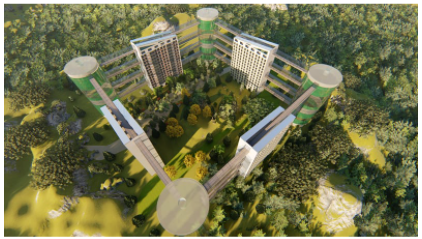
Projects such as LifeCityLand and LifeInForestLand demonstrate the potential of environmentally sustainable urban development. Their success will depend on rigorous financial planning, investor engagement, and the ability to demonstrate both economic and social benefits.
8. Furniture Materials and Healthy Indoor Environments
The experts highlighted the importance of using safer construction and furniture materials. Natural wood, environmentally friendly finishes, and low-emission products were identified as preferable alternatives for promoting healthier living environments. Proper sealing of engineered wood products and careful material selection can significantly reduce health risks associated with indoor pollution.
Source: EcoResearch 3, 2019.

